
 Ballantine Law
Your Will Doesn’t Automatically Control Your Super. Here’s What Australians Need to Know
Superannuation and wills do not always work together in the way many Australians expect.
If you have a valid will, it is easy to assume that everything you leave behind will be distributed according to the instructions in it. But there is one major asset that works differently.
Your superannuation does not automatically form part of your estate, and your will does not automatically decide who receives it when you die.
For many Australians, that matters more than they realise. Your super death benefit can include not only the balance you have accumulated over your working life, but also any life insurance held through your super fund.
That means a significant amount of money could potentially be distributed differently from the rest of your estate if your superannuation arrangements and your will have not been planned together.
Understanding how superannuation and wills interact is therefore an important part of a complete estate plan.
How superannuation and wills work together
Most assets that you personally own, such as money in a bank account, investments or property held in your own name, can form part of your deceased estate. Your executor or administrator then deals with those assets according to your will or, if you do not have a valid will, according to the laws of intestacy.
Superannuation is different because the money is held within your super fund.
When you die, the trustee of your super fund must deal with your superannuation death benefit according to superannuation law, the fund’s rules and any valid beneficiary nomination you have made.
That is why simply writing someone’s name into your will does not necessarily mean that person will receive your super.
Your super may instead be paid directly to an eligible beneficiary, or it may be paid to your legal personal representative and become part of your estate.
The key is making sure those arrangements support the intentions recorded in your will rather than accidentally working against them.
Who can receive your super when you die?
Under Australian superannuation rules, only certain people can generally receive a super death benefit directly. The Australian Government’s MoneySmart guidance on super death benefits provides further information about eligible beneficiaries and beneficiary nominations.
Under superannuation rules, eligible recipients can generally include:
- your current spouse or partner
- your children
- someone who was financially dependent on you
- someone with whom you had an interdependency relationship
- your legal personal representative, meaning your estate
You may be able to nominate one eligible beneficiary or divide the benefit between several eligible beneficiaries, depending on your circumstances and the rules of your super fund.
This is one reason estate planning should look beyond the wording of your will. The beneficiary you want to provide for must also be someone your super fund can legally pay.
What is a superannuation beneficiary nomination?
A beneficiary nomination tells your super fund who you would like your super death benefit to be paid to when you die.
There are different types of nominations and not every super fund offers every option.
Binding death benefit nomination
A valid binding death benefit nomination generally requires the trustee to pay your super death benefit according to the nomination, provided the nominated beneficiaries remain eligible and the nomination complies with the fund’s requirements.
This can provide considerably more certainty about where your super will go.
Some binding nominations are lapsing nominations. These expire after a specified period, commonly three years, and need to be renewed if you want them to remain binding.
Other funds may allow non lapsing binding nominations, which do not automatically expire.
Each fund can have its own requirements, so it is important to check the rules that apply to your particular nomination.
Non binding beneficiary nomination
A non binding nomination tells the trustee who you would prefer to receive your super, but it does not necessarily require the trustee to follow your wishes.
The trustee can consider your nomination alongside your family circumstances, eligible beneficiaries, superannuation law and the fund rules before deciding how the benefit should be paid.
Does superannuation form part of your estate?
Not automatically, but it can.
If your super death benefit is paid directly to an eligible beneficiary, it generally does not first pass through your deceased estate.
However, you may be able to nominate your legal personal representative to receive your superannuation death benefit.
If the fund pays the benefit to your legal personal representative, the money becomes part of your estate and can then be administered together with your other estate assets.
If you have a valid will, this means the benefit can ultimately be distributed according to the relevant provisions of your will.
That does not mean directing your super into your estate is always the best option. Paying a death benefit directly to a beneficiary and paying it through an estate can have different legal, tax and estate planning consequences.
The appropriate approach depends on your family circumstances, your beneficiaries, the structure of your estate and what you are trying to achieve.
Six common superannuation and wills mistakes
Problems often arise not because someone failed to make a will, but because their will and superannuation arrangements were considered separately.
1. Assuming your will controls your super
This is perhaps the most common misunderstanding.
You might carefully prepare a will stating that your estate is to be divided between particular family members, while an entirely different beneficiary nomination remains attached to your super.
A later change to your will does not automatically rewrite your superannuation nomination.
2. Having no beneficiary nomination
If you die without a valid nomination, the trustee of your super fund may need to decide who should receive your death benefit according to superannuation law and the rules of the fund.
The eventual outcome may not be the same as the distribution you intended under your will.
It can also create additional uncertainty for family members at an already difficult time.
3. Letting a binding nomination expire
A nomination that was valid when you completed it years ago may no longer have the same effect today.
Some binding nominations lapse after a set period. If the nomination has expired, it may no longer bind the trustee in the way you expected.
Checking the expiry date and requirements of your nomination should therefore be part of reviewing your estate plan.
4. Updating your will but forgetting your super
Life changes.
You may marry, separate, divorce, enter a new relationship, have children or grandchildren, lose a loved one or experience a significant change in your financial circumstances.
Many people remember to update their will after a major event but forget that their superannuation beneficiary nomination may also need reviewing.
Your will and super arrangements should tell the same overall estate planning story.
5. Forgetting about life insurance inside your super
Your super death benefit may be worth considerably more than the account balance shown on your statement.
Many Australians also hold life insurance through their super fund. If you die while that cover is in place, the insurance proceeds may be added to the amount payable as your superannuation death benefit.
For example, someone with $200,000 in accumulated super might also have several hundred thousand dollars of life insurance through the fund.
That can turn what appears to be one part of an estate plan into one of its largest financial components.
6. Assuming every beneficiary will be treated the same
Superannuation law determines who can receive a death benefit, while taxation law can affect how that benefit is taxed.
The tax treatment can vary according to the beneficiary’s relationship with the deceased, how the benefit is paid and the components of the benefit.
This is another reason beneficiary nominations should not be considered in isolation from the wider estate plan.
A simple example of how a will and super can produce different outcomes
Imagine Sarah has prepared a will leaving her estate equally to her two adult children.
Several years earlier, however, she made a valid binding death benefit nomination directing her superannuation death benefit to her spouse.
Sarah later changes her will but does not review her super nomination.
If that binding nomination remains valid when Sarah dies and her spouse remains an eligible beneficiary, the super fund may be required to pay the super death benefit to her spouse rather than divide it between the children according to her will.
The will itself has not failed.
The issue is that the will and the superannuation nomination were directing different assets to different people.
Your will and your super nomination need to tell the same estate planning story.
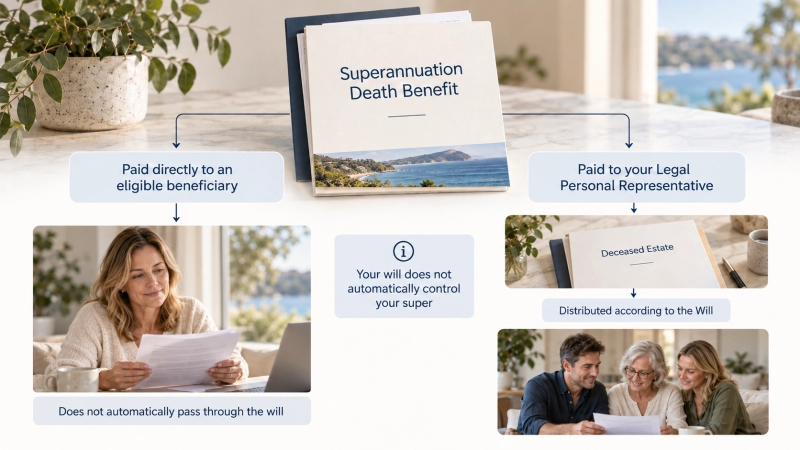
How superannuation and wills work together – Ballantine Law Bundaberg
Should you nominate your estate to receive your super?
For some people, nominating their legal personal representative can make sense because it allows the super death benefit to be dealt with as part of the broader estate.
For others, paying the benefit directly to an eligible beneficiary may be preferable.
The answer can depend on factors such as:
- who you want to benefit
- whether your beneficiaries are eligible to receive super directly
- the tax position of potential beneficiaries
- whether your will contains a testamentary trust
- the value and structure of your other assets
- your family circumstances
- the possibility of disputes or claims against the estate
- the rules of your particular super fund
This is not a decision that should be made simply because one option appears easier.
The aim is to structure your will, superannuation nomination and other estate planning arrangements so they work together to achieve the outcome you actually intend.
When should you review your super beneficiary nomination?
Estate planning should not be treated as something you complete once and forget about.
It is sensible to review your superannuation beneficiary nomination alongside your will, particularly after significant changes such as:
- marriage or entering a new relationship
- separation or divorce
- the birth or adoption of a child
- the death of a beneficiary
- a significant change in your assets or superannuation balance
- changing super funds
- moving into retirement
- creating or changing a testamentary trust
- any major change in your family circumstances
Even if nothing significant has changed, it is worth checking whether your nomination is still valid and whether the people named in it remain the people you genuinely want to benefit.
A seven point super and estate planning check
If you already have a will, take a few minutes to check whether your super arrangements support it.
- Check who your current super beneficiary is. Do not rely on memory. Confirm it with your fund.
- Check what type of nomination you have. Find out whether it is binding, non binding, lapsing or non lapsing.
- Check whether your nomination expires. If it does, note the expiry date and the fund’s renewal requirements.
- Check whether the people you nominated are still eligible. Family circumstances can change over time.
- Check your insurance through super. Understand the potential value of your total death benefit rather than looking only at your account balance.
- Compare your nomination with your current will. Make sure the two arrangements work together rather than producing an unintended outcome.
- Review both when life changes. Treat your will and super beneficiary nomination as connected parts of the same estate plan.
Superannuation and wills should be planned together
A well prepared will is an essential part of estate planning, but it is not the whole picture.
Your superannuation could represent one of the largest amounts of money available to your family after your death, particularly when life insurance is included.
If your beneficiary nomination and your will have been prepared at different times, or without considering how they interact, it is worth reviewing them together.
At Ballantine Law, we help clients look at the complete estate planning picture. This can include your will, beneficiary arrangements, family circumstances and other important planning documents so that each part works towards the outcome you intend.
Learn more about our Wills & Estate Planning services in Bundaberg.
You may also find our guide to Enduring Powers of Attorney helpful when considering the other documents that form part of a complete estate plan.
Superannuation and wills frequently asked questions
Does my will control my superannuation?
No, not automatically. Your super fund deals with your death benefit according to superannuation law, the fund’s rules and any valid beneficiary nomination you have made. Your will becomes relevant if your super death benefit is paid to your legal personal representative and becomes part of your estate.
Does superannuation form part of my estate?
Not automatically. Super may be paid directly to an eligible beneficiary. It can form part of your estate if the super fund pays the death benefit to your legal personal representative.
Who gets my super if I die without a beneficiary nomination?
If there is no valid binding nomination, the trustee of your super fund generally determines how the death benefit should be paid in accordance with superannuation law and the fund’s rules. This may include payment to one or more eligible dependants or to your legal personal representative.
Can I nominate my children to receive my super?
Children can generally be eligible beneficiaries under superannuation law. However, the tax treatment of a super death benefit can vary depending on the beneficiary’s circumstances, so eligibility to receive the benefit and taxation of the benefit are separate considerations.
Do binding death benefit nominations expire?
Some do. Lapsing binding nominations commonly expire after a specified period, often three years. Some funds also offer non lapsing binding nominations. Check your fund’s rules and your nomination documentation rather than assuming your nomination remains current.
Should I update my super beneficiary when I update my will?
They should generally be reviewed together. Updating one without checking the other can leave two important parts of your estate plan pointing in different directions.
Make sure your will and super work together
If you have already made a will but cannot remember when you last checked your super beneficiary nomination, now is a good time to review both.
Ballantine Law can help you review your estate planning arrangements, identify potential gaps and make sure your documents reflect what you actually want to happen.
Request a free 15 minute consultation with Ballantine Law and take the next step towards an estate plan that works as a whole.
This article contains general information only and does not constitute legal, financial or taxation advice. Superannuation fund rules and individual circumstances vary. You should obtain advice relevant to your circumstances before making or changing an estate planning or superannuation arrangement.
Disclaimer
This article is for informational purposes only and is not intended as legal advice. Each individual's situation is unique, influenced by various legal and personal factors. We strongly recommend seeking personalised legal counsel to address your specific circumstances and legal requirements. Ballantine Law, its agents, and authors are not liable for any actions taken, or losses incurred, based on the content of this article. For a personal consultation that takes into consideration your personal needs and circumstances, please click here.
 Ballantine Law
 Ballantine Law
 Ballantine Law
 Ballantine Law
 Ballantine Law
 Ballantine Law